
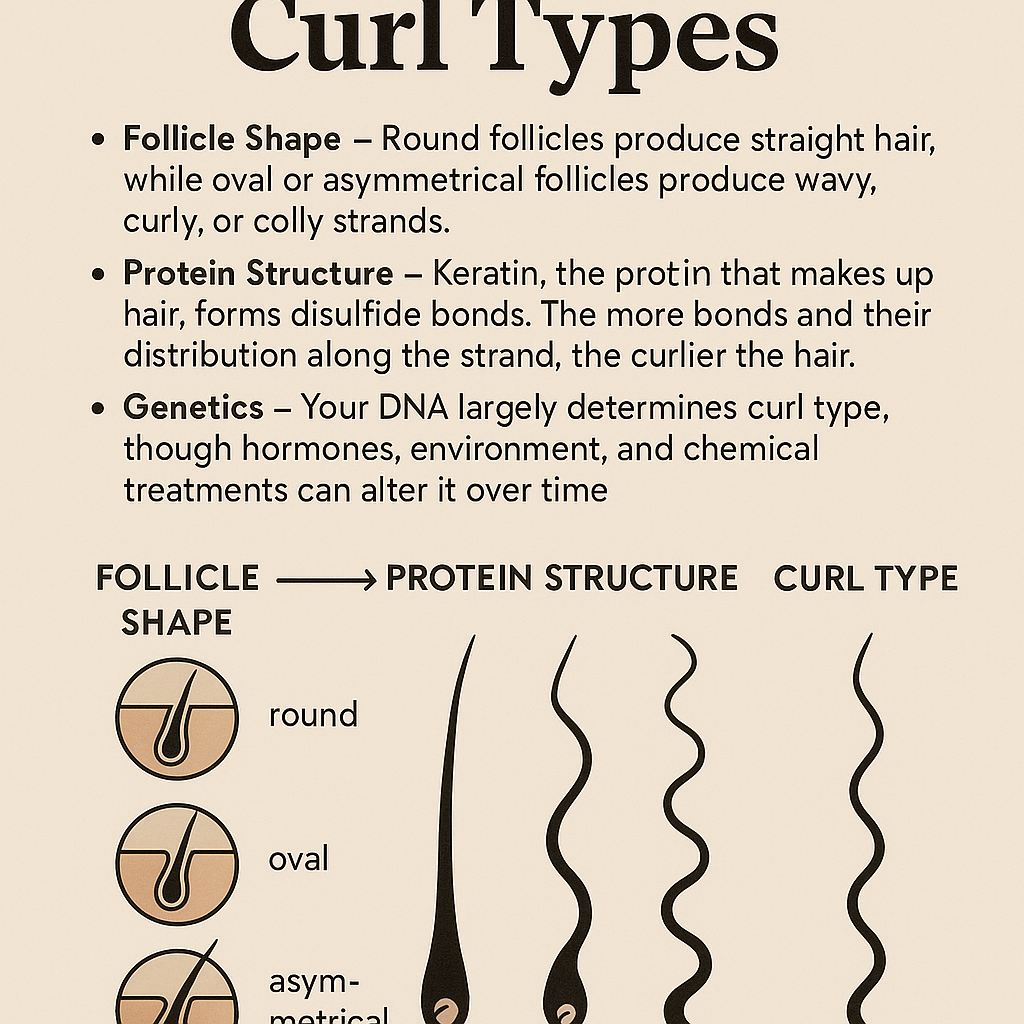
Curls are more than a hairstyle—they are the product of science, genetics, and evolution. The foundation of curl type begins with the hair follicle: round follicles create straight hair, oval follicles produce waves, and asymmetrical follicles form curls or coils. Inside each strand, keratin proteins and disulfide bonds shape the curl pattern. The more bonds and the less evenly they are distributed, the curlier the hair becomes.
Genetics also play a major role. Specific genes, like the trichohyalin gene, influence curl formation, while evolutionary history shaped curl patterns across populations. Environment and hormones add another layer, with humidity, aging, and life changes like pregnancy altering curl behavior.
Curly hair has unique needs because its structure makes it harder for scalp oils to travel down the strand, leaving it prone to dryness and frizz. This explains why hydration, leave-ins, and oils are so essential.
By understanding the science of curl types, individuals can better identify their own patterns and choose products and routines that fit. Ultimately, curls are not a challenge—they are a sophisticated structure that deserves tailored care and celebration. …
Continue ReadingThe Science Behind Curl Types: Why Our Hair Grows the Way It Does