Introduction
Curls have fascinated humanity for centuries. They are celebrated in art, literature, and culture as symbols of beauty, identity, and individuality. But beyond the aesthetics, curls are rooted in science. Understanding the biological and structural foundations of curl types is essential not only for embracing their beauty but also for learning how to properly care for them.
Too often, curly hair is dismissed as “unruly” or “frizzy,” when in fact, it is a sophisticated structure shaped by genetics, follicle design, protein composition, and even environmental influences. To appreciate curls, we need to begin with science: why they exist, how they are formed, and what determines the wide variety of curl types we see in the world.
In this article, we’ll explore in detail:
- The role of follicle shape in determining curl type
- How keratin proteins and disulfide bonds create curl patterns
- The influence of genetics and evolution on hair texture
- The impact of environment, hormones, and chemical treatments
- Why curly hair has unique hydration and styling needs
- Practical insights for identifying and caring for your curl type
By the end, you’ll not only understand the science behind curls but also gain the tools to nurture and celebrate your natural texture.
Section 1: Follicle Shape – The Blueprint of Curls
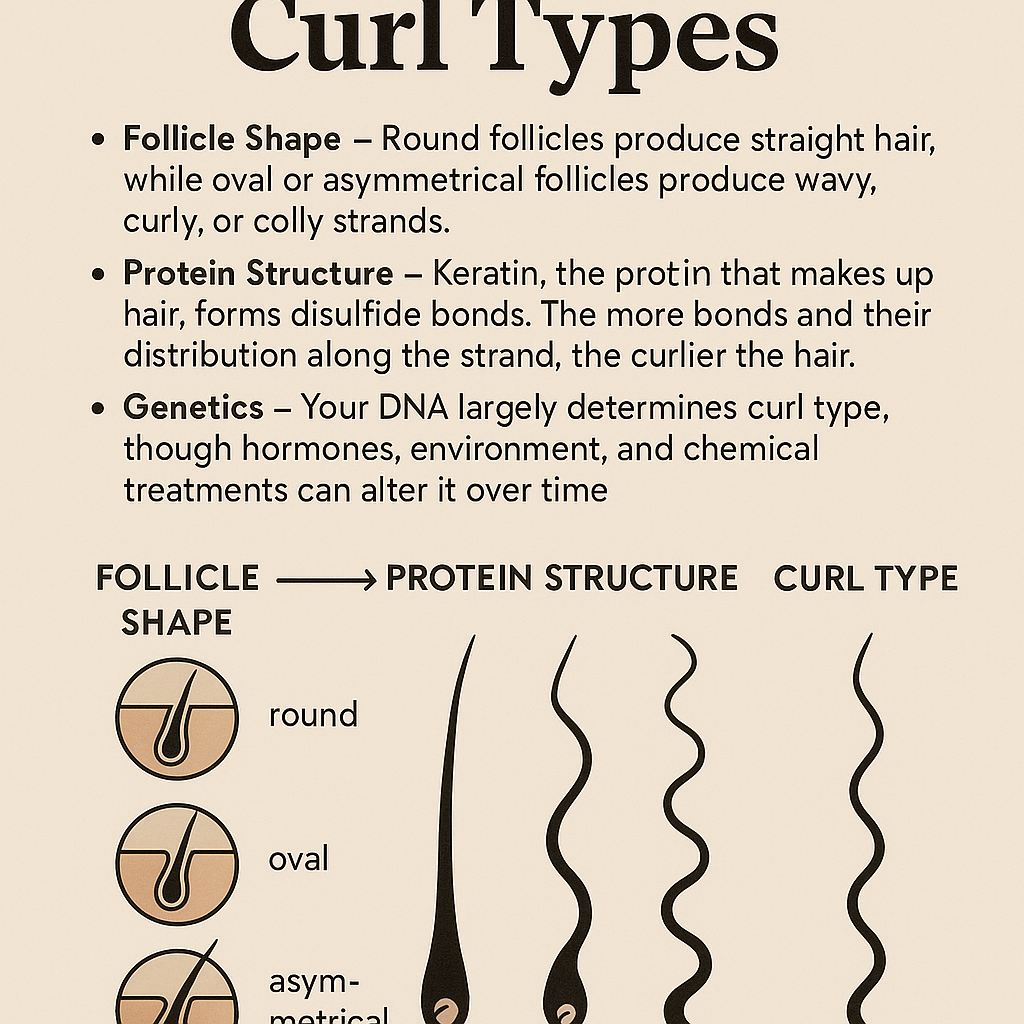
The journey of a curl begins at the follicle, the tiny tunnel in the scalp from which each strand of hair grows. Follicle shape is one of the most important determinants of hair texture.
Round Follicles = Straight Hair
- When follicles are perfectly round and symmetrical, hair grows straight.
- The strand emerges evenly, without bends or twists.
Oval Follicles = Waves and Loose Curls
- Oval or slightly flattened follicles push hair to grow in an “S” shape.
- The more oval the follicle, the more pronounced the wave or curl.
Asymmetrical Follicles = Tight Curls and Coils
- Follicles that are highly curved or asymmetrical create strong bends in the hair strand.
- This results in tightly coiled or kinky textures.
Follicle angle also matters. When follicles are angled diagonally to the scalp instead of vertically, the hair grows with more curl. Thus, follicle shape and angle together determine whether hair emerges straight, wavy, curly, or coily.
Section 2: Protein Structure – Keratin and Disulfide Bonds
While follicles create the blueprint, keratin proteins build the architecture of each strand. Hair is made primarily of keratin, and within keratin, the arrangement of disulfide bonds is what determines curl pattern.
The Role of Keratin
Keratin is a fibrous protein that provides structure, strength, and elasticity. It is organized into chains that coil around each other like springs.
Disulfide Bonds = Curl Makers
- Disulfide bonds are strong chemical links between sulfur atoms in keratin.
- The more disulfide bonds a strand has, the curlier it will be.
- Their distribution along the strand creates bends and twists.
For example:
- Straight hair has evenly distributed bonds.
- Curly hair has bonds concentrated in specific areas, forcing the strand to bend.
- Coily hair has dense, irregular bonds, producing tight zig-zag patterns.
Why Chemical Treatments Work
Straightening or perming alters disulfide bonds. Relaxers break them to loosen curls, while perms create new bonds to add curl to straight hair. However, these treatments can weaken the hair’s protein structure if not done carefully.
Section 3: Genetics – The DNA of Curls
Genetics play a huge role in determining curl type. Studies have identified specific genes that influence follicle shape and keratin structure.
- The trichohyalin gene (TCHH): Strongly linked to curl formation.
- Inheritance: Curl patterns are often passed from parents to children.
- Diversity: Mixed genetic heritage can create multiple curl types on one head.
Interestingly, curl patterns also reflect human evolution. Populations in hotter climates often developed tighter curls, which provide protection against UV rays and help regulate scalp temperature. In contrast, populations in cooler climates tended to develop straighter hair, which conserves heat.
Section 4: Environmental and Hormonal Influences
While genetics provide the blueprint, environment and hormones influence curl expression over a lifetime.
Environment
- Humidity: Moisture in the air interacts with disulfide bonds, increasing curl and frizz.
- Dry climates: Lack of moisture leads to brittle curls and breakage.
- Water quality: Hard water with minerals can alter curl definition.
Hormones
- Puberty: Increased hormones can change curl patterns.
- Pregnancy: Many women experience curlier or thicker hair.
- Aging: Follicles may change shape over time, loosening curls.
Chemical Treatments and Damage
Coloring, bleaching, and frequent heat styling can permanently alter curl patterns by damaging keratin and disulfide bonds.
Section 5: Why Curly Hair Has Different Hydration Needs
Curly hair is not “frizzy straight hair”—its structure makes it uniquely prone to dryness.
The Moisture Challenge
- Sebum (natural scalp oil) travels easily down straight strands.
- In curls, the bends and coils slow the oil’s journey, leaving mid-lengths and ends dry.
- This is why curly hair often looks dull or frizzy without extra care.
Hydration Solutions
- Deep conditioning: Restores moisture balance.
- Leave-in conditioners: Provide all-day hydration.
- Oils and butters: Seal in moisture and reduce frizz.
Section 6: Identifying Curl Types Through Science
Using follicle shape, protein structure, and shrinkage patterns, curl types can be classified scientifically. The Andre Walker Hair Typing System remains the most popular:
- Type 2 (Wavy): Loose “S” shapes, fine to coarse.
- Type 3 (Curly): Spirals and ringlets, medium to tight.
- Type 4 (Coily/Kinky): Dense coils, zig-zags, with high shrinkage.
However, most people have a combination of curl types, and factors like density, porosity, and thickness further complicate classification.
Section 7: Practical Implications – Care by Curl Type
Wavy Hair (Type 2)
- Needs lightweight hydration.
- Avoid heavy oils that weigh it down.
Curly Hair (Type 3)
- Requires consistent moisture.
- Benefits from curl creams and gels.
Coily Hair (Type 4)
- Needs intense hydration and protective styles.
- Shrinkage means styles often look shorter than actual length.
Section 8: Styling Through the Lens of Science
Understanding science helps explain why certain styling methods work better for curls.
- Plopping: Works because fabric absorbs excess water without disturbing curl bonds.
- Diffusing: Heat + airflow speeds up drying without breaking natural curl formation.
- Twist-outs/Braid-outs: Temporarily reshape disulfide bonds for more defined coils.
Section 9: Cultural and Psychological Dimensions
Hair is not only biology; it’s identity. Many cultures celebrate curls as symbols of pride, freedom, or heritage. At the same time, societal pressures to straighten hair often ignore the science behind curls, framing them as “unmanageable.” Understanding curl science reframes the narrative: curls are not unruly—they are intricate, purposeful structures shaped by evolution and biology.
Section 10: The Future of Curl Science
Ongoing research is deepening our understanding of curl genetics and biology. Advances in trichology (the study of hair) may lead to personalized haircare based on DNA, scalp microbiome, and protein structure. Imagine a future where products are tailored specifically to your genetic curl type.
Conclusion
The science behind curl types reveals a fascinating interplay of follicle shape, protein structure, and genetics. Beyond beauty, curls are the result of evolution, biology, and chemistry. Understanding their structure explains why they require different hydration, care, and styling methods than straight hair. By embracing this knowledge, we not only care for our curls better but also celebrate them as a natural expression of individuality.
Curls are not a flaw to be tamed but a crown to be understood, nurtured, and embraced.
Leave a Reply